
Design Thesis
Master of Architecture(2014) , University of Manitoba
Pre: Keep the Street Empty for Me
In the city, we need to be enclosed by something, whatever visible or invisible, perceivable or unperceivable. We are enclosed by materiality of artificiality from city. Artificiality creates the benefit of living and limitation of behavior with materiality of itself.
Artificiality is become a “vessel” of people – hold us and limits us in same time, and always gives us an “offer”, and passively waiting us response back to them. If some human behavior happened without these offer, that become the phenomenon beyond common sense of society, such like sleeping on the street. This is not supposed to be happened in our memory/discipline.
If we could see “One people sit on a chair,” this phenomenon as a whole, it is not a people, neither a chair. It is something else with chair and people as its content. We could apply the same idea on a bed, a room, a building, a street; on any “vessel” could hold us. We could erase our body reference by this artificiality.
The video deals with most vulnerable position of people – sleeping to represent an invisible boundary in the public street, try to explore the possible “vessel” of individual people.
在城市中,我们总是习惯于被什么东西包围着。无论这个东西是可见的还是不可见的,可感知的还是不可感知的,我们都总是被这些人工物品有意无意的包容在城市中。这些人工产物的物质性同时带来了我们日常行为的益处和限制。
所以这些人工造物成为了人类的“容器”- 包容我们,也限制着我们,同时又常常给我们一种信号,但却又被动的等待着我们回应它们。但是,如果人类个体的行为发生在没有接受到这种“信号”的情况下,那么这种行为往往都是有背常规的。就像在街道上睡觉一样,睡觉这种行为在我们脑海中是不应该发生在街道上的。
但是如果我们如果可以把“人坐在椅子上”这个现象看做一个整体,那这不再是人,也不再是椅子,而是一个什么其他东西,而这个东西的内容是人和椅子。这是一种容器。我们同样可以把这个观点应用于一个床,一栋建筑,一条街道 – 所有可以成为我们的“容器”的东西上。我们利用这些人工产物消除了我们自身的身体。
短片是关于人类最易被侵犯的姿态 – 睡眠。试图把这种姿势置于街道中,去代表公共空间中的这种不可见的边界。同时试图发现这些可能可以承载个体人类的“容器“。
– UABB 2013
Abstract
Sleep is a basic biological need of human beings, and almost takes half of our lifetime. People always have an “image” of some place that they call it “home”. These “images” tend to represent privacy and comfort. People have endlessly discussion how to maximize privacy in residential buildings. However, no place of sleep is totally private; rather, the degree of private and public experience in an artificial space is always fluctuating.
If this idea were extended to all artifacts related to human behavior, then the materiality of the artifacts would always offer people to choose a position to fit into that artifact. An intentional design is basic on a mediocre phenomenon that designer tries to use a programmatic object to push a kind of activity of people on this particular design. Particular for sleeping, a room, which is one kind of artifact, block the view of outside people but diffuses views and sounds because holes, doors or windows. The environment of the room starts to change the character of interior, and affect inside behavior of people. But people also have their diverse own reaction to the artifact and environment coursed by their memory of entire life. When people sleep, people are in a vulnerable position, an extreme situation in private and public experiments; with fluctuating of degree of privacy, any artifact could become “sleeping vessel” of people to challenge the bottom line of minimum privacy of sleeping.
If assume this most vulnerable position as the only need of residential building, there have a possibility that erase the hierarchy of privacy and consequence of space in dwelling, and a single standard appeared: we all sleep in the city, and our dreams diffuse across the city. People don’t need to indicate the boundary of sleeping space in their mind; artifacts and environments build the limitation of sleep in human world physically or perceptually. On the other hand, if people living without all artifacts and environment, people maybe will isolate by vacuum, but still have a similar condition and some none hierarchy connections between all sleeping bodies. Project will try to erase this hierarchy of privacy firstly, and the fluctuating degree of privacy will be a reinsertion in between different sleeping bodies to create a new horizon of sleep vessel.
Intentions
Over the last century, real estate developers, builders and architects already got the million of developing method and strategy of residential sector in city; nevertheless, those completed residential buildings only meet part of our social needs, especially in a city with high population density. Social class structure does not only constitute by normal citizens, but also involve who don’t have a stable place in city; there have some groups of people who live and work in a big city, while without city-registered residence and change their houses from time to time. Travelers or visitors also have similar situation in the city.
This thesis will develop a design for a hotel and hostel, a type of residential building that provides sleeping spaces for temporary residents of city. This kind of building manifests a permanent construction in which change is also inherent. This type of architecture tries to make up a feeling of “home image” to temporary residents in a strange city. Hotels have their standard and always about luxury, but hostel is more particular dealing with lower class people. People come to hostel, pay and own a sleeping spot, leave in next day. The transformation is quick and unpredictable. There have so many interactions to each other, and many of semipublic space engaged with privacy of resident.
This project proposes to renovate an existing hostel in New York City – Bowery’s Whitehouse Hostel. This is a flophouse commercially operating as a hostel with very basic conditions located on Bowery Street since 1917. Analyze of these interesting and complex building and environment conditions will manifest the social engagement with past and potential of future. On the other hand, these conditions also provoke a great research base of “sleeping in the city”, and allow this project to discover a new spatial interpretation of public sleeping issue. With complexity and contradiction of public sleeping condition, the perception of people inside and outside of sleeping space plays an important role of the atmosphere in the building; therefore, this project need to approach the present of this very subjective human feeling with concrete manifestation of sleeping space.
For the expectation of project, this hostel is going to create an unusual type of sleeping space, which keep the minimum private experience of people but contribute indirectly connections between different inhabitants. These connections as a society of dreamers, become a networking between sleepers, passengers and travellers when they trying to find a place temporally for sleeping. Movement during the day and consciousness from unfamiliar city of these people make this society not only connects people, but also connects with the city contexts. Project will spatially represent these unsubstantial connections between dreamers in the new design, and renovate a mental social type sleeping space base on exist and regular grid of sleeping spots in the Bowery’s Whitehouse Hostel. The new space still provides the basic privacy, but allows the projection and reception of emotional signal diffusing between different occupants and environments; and, this is the approach that project tries to present the expected society of dreamers during the design.
Processes
The processes of this research project could be divided into three parts: the projection and reception of consciousness; explorations into the relationship between body and room; and the design of a floating city and floating dreams.
Map drawing
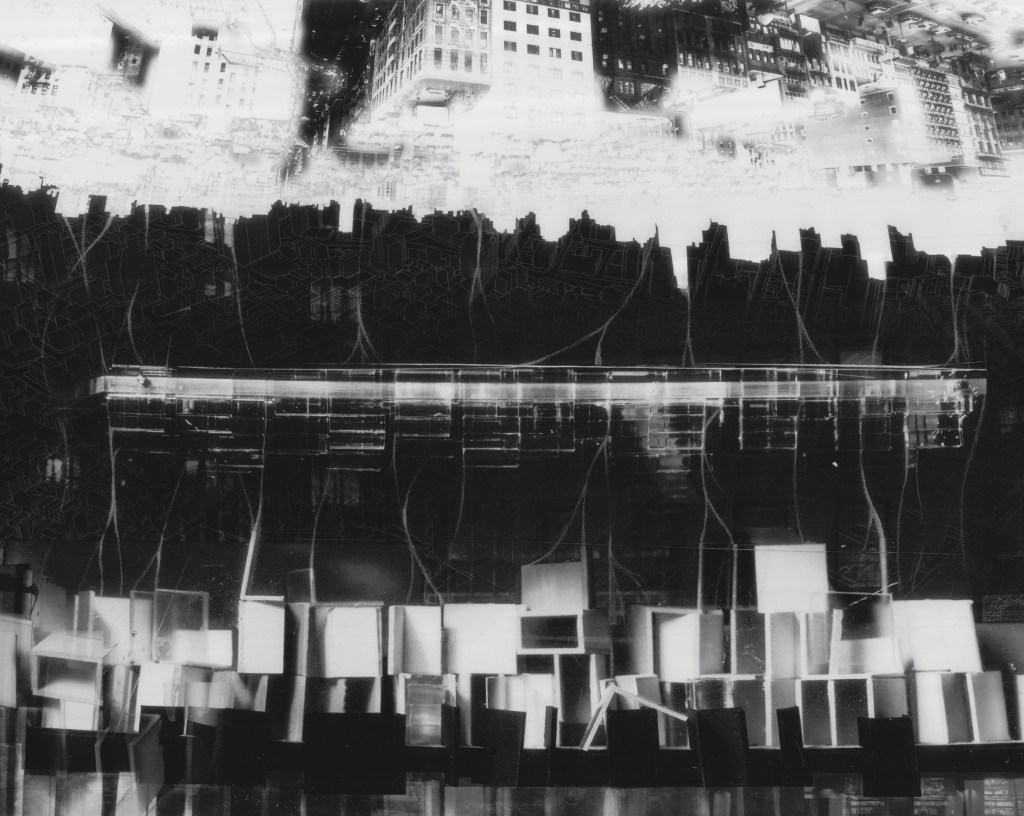
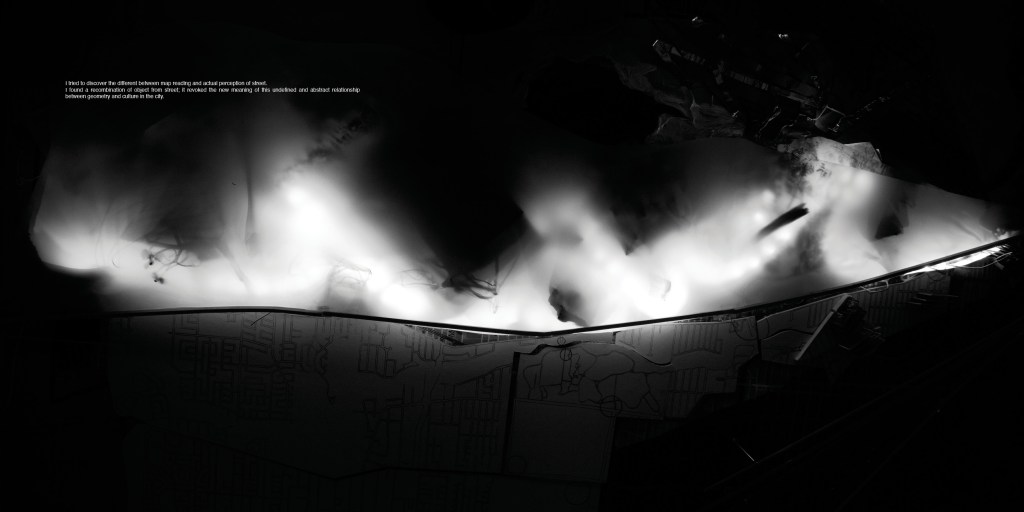
The preparation of project starts with a collective mapping drawing of Winnipeg. In order to represent the perception of city, the research base on the idea of emotional projection of me, which is one of the regular individual in the city. Map drawing set multiple layer of item underneath a white screen: watercolor drawing of initial understanding of Portage Ave, collage of photo from surrounding area, selected one to one objects from street. A Led strip emit the light from underneath; this map redefine the shadow as a representative phenomenon with double face: casted by physical signal and emotional signal, approach with this phenomenon with geometrical and cultural aspect, and the process of diffusing of light, try to discover the layers of meaning behind projection and reception of consciousness. On the screen, map becomes a readable black and white drawing. This placement of object and shadow works give this recombination a new meaning, which is the emotional signal from global world, but appear in the scale of human eye.
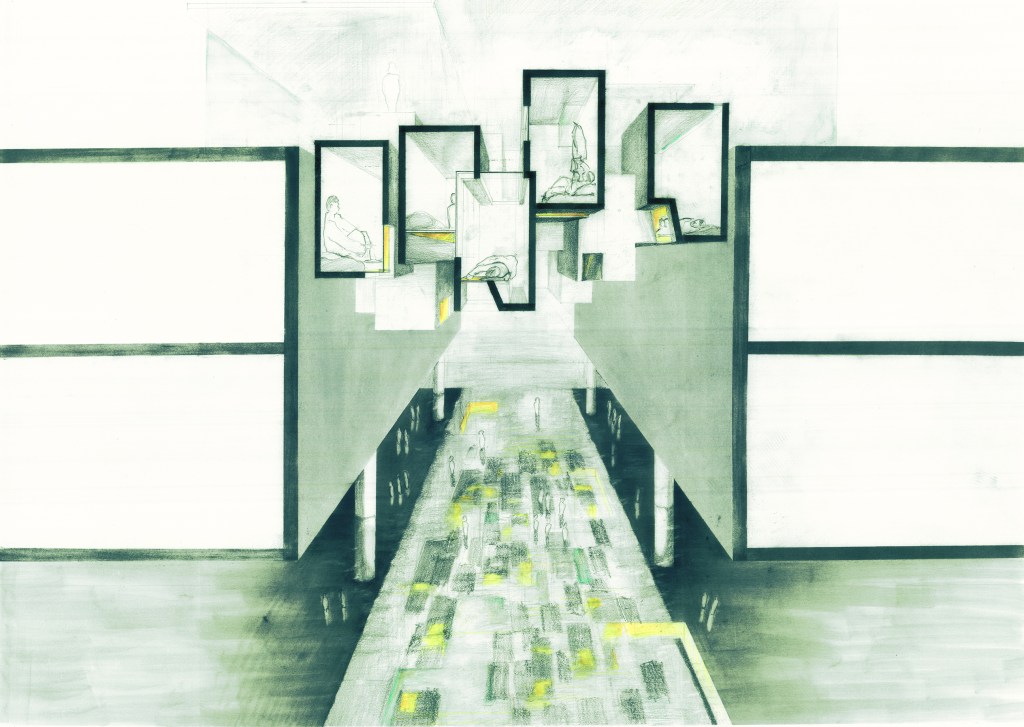
Map drawing is primary talking about an individual subjectively project his/her consciousness to the city on a scaled map. But emitter could never know the response of city because the great jumping between scale of city and map; therefore, research created a setting from my imagination, which the emitter and receiver are equal in the situation. A perspective plan drawing of multiple scenarios between different passengers in an intersection shows the projection and reception of consciousness between different individual in an entirely public space. Continually, A short film named “Keep the Street Empty for me” worked with similar idea, but additionally insert the most vulnerable position of people – sleep – into projection and reception of consciousness process. Film test the bottom line of the acceptance of public sleep on the street, and explores that how to keep the street consciously empty for people in order to feel comfortable sleep over there.
Dream Vessel
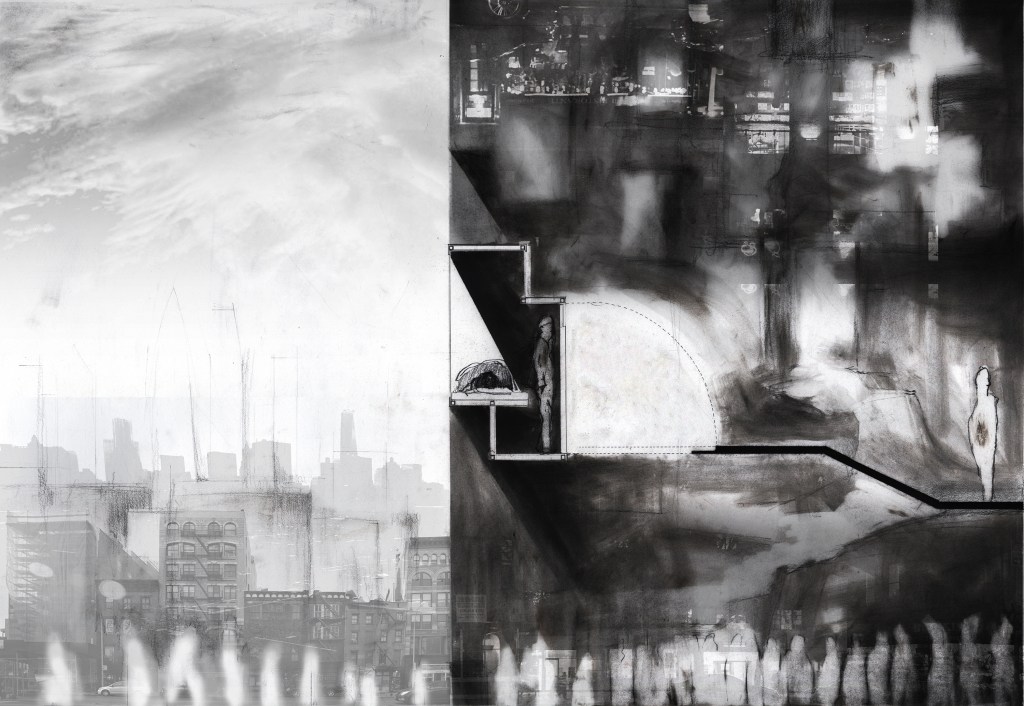
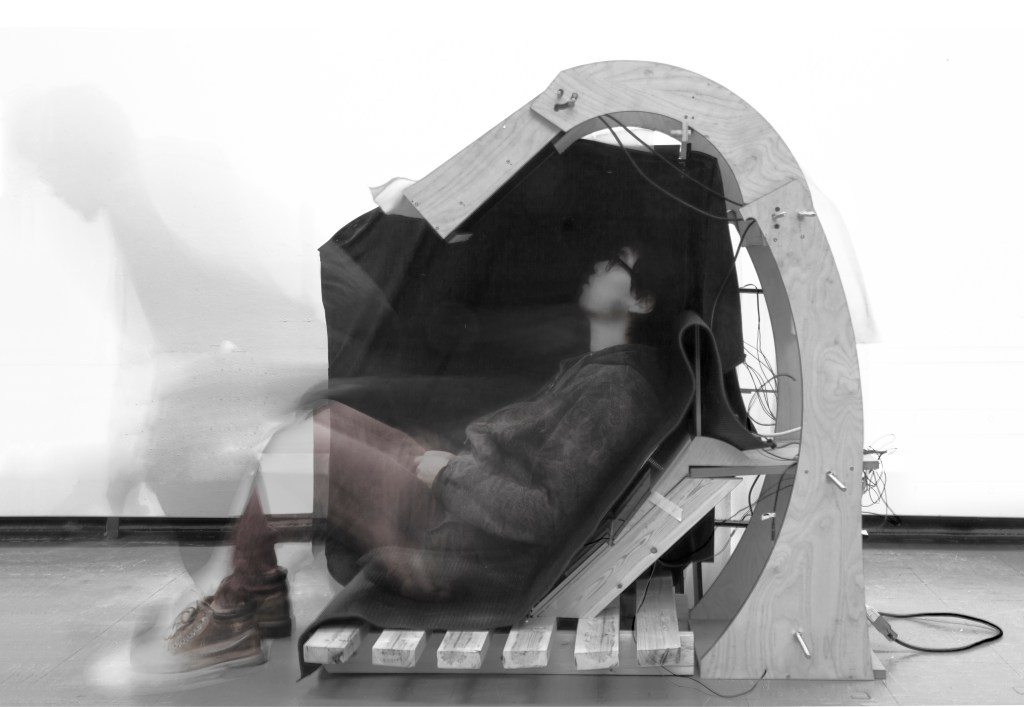
From intersection drawing and film work, project discovered the consciousness between different people in the public space, and invisible boundaries between people and people, public and private. In term of sleep, a full-scaled construction started to experiment the relationship between an ultra private space and public space. This construction intent to make a shapeless vessel of sleeping, and locates this vessel in a public space. Inside of this vessel, the darkness provides a quiet and comfortable chair for people, and blocks the physical connection with outside public space; therefore, a physical boundary created between public and private space. However, in order to erase this boundary and make a conceptual connection between inside and outside, this construction inserts a monitor inside of vessel, which connect with a camera for looking at both outside and vessel itself. Also, this construction uses some technology that inside dark surface is able to detect some static inside motions of body, and respond these motions on outside bright surface of vessel. Ultimately, outside people able to know state of inside people by the Led strips on outside surface of vessel, but don’t know the exactly position of inside people. Inside people capable to detect situation of outside by monitor and camera. If I summery this process, it should be described like this: a signal unintentional emitted by sleep people inside, transformed by the surface of vessel to outside space, and the people of outside received this signal and maybe react to the vessel, then inside people received the alterative signal by the monitor and maybe react it again. This construction is only the individual issue. But if this indirectly connection could build between multiple individual, there may create networking of this connection – the society of dreamers may appear.
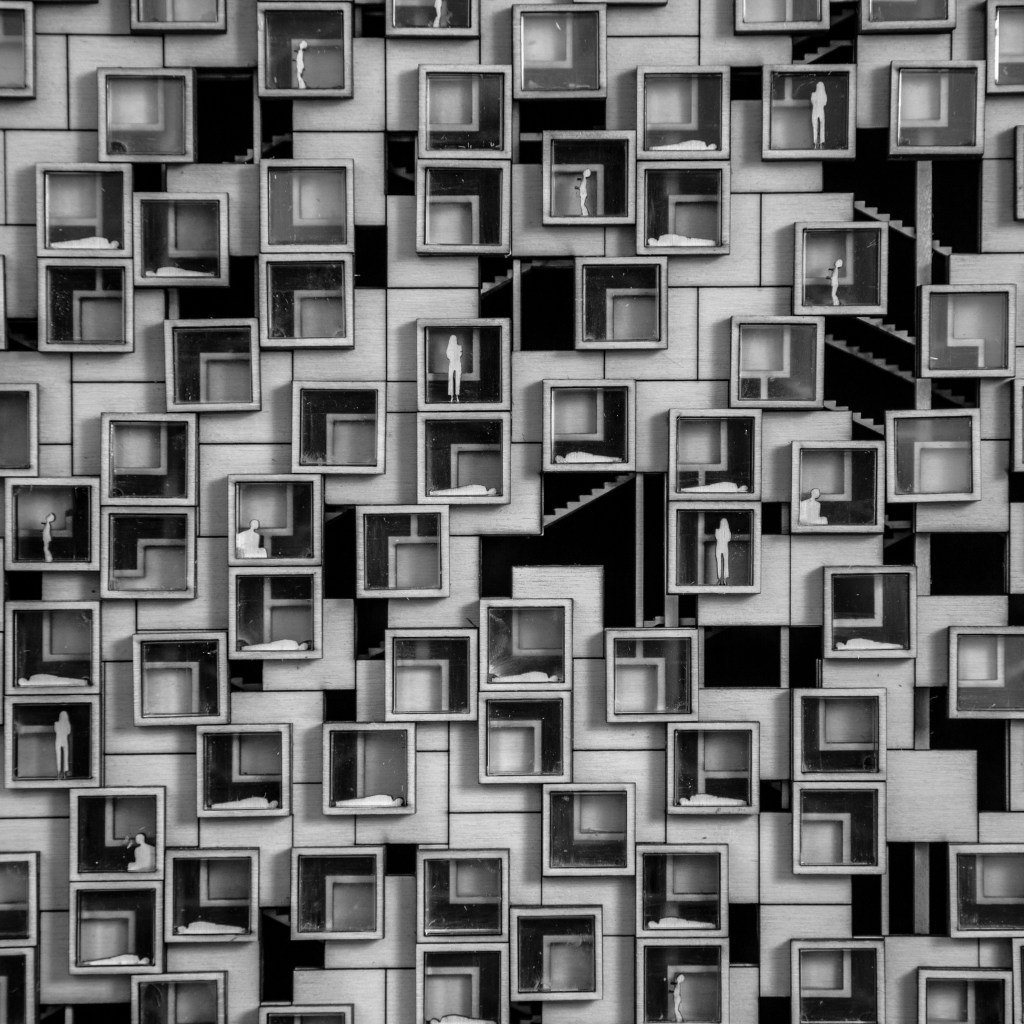
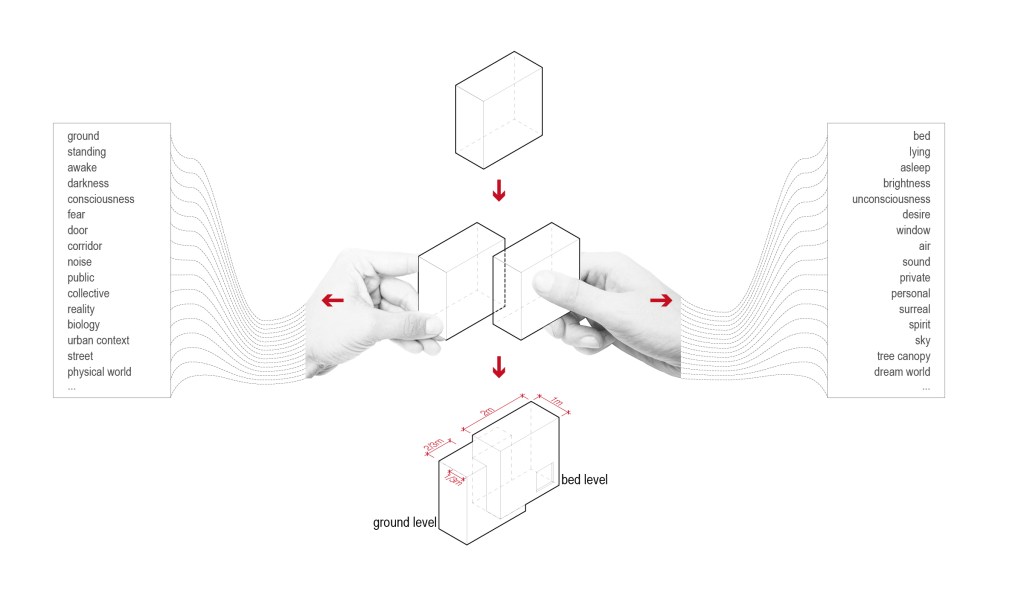
48 Boxes of sleep drawing and The Feeler of body
In order to experience a specific situation of public sleep in a high-density city, I traveled to New York City. This one-week field trip gave me a chance to observe the Bowery’s Whitehouse Hostel, which is location in a complex and high-density context. The existing conditions of the hostel inspired a series of analysis drawings of the living experience in this hostel. Base on the condition of hostel, this analysis drawing tries to discover diverse possible directly or indirectly connection between body and room. If we could see “One people sit on a chair,” this phenomenon as a whole, it is not a people, neither a chair. It is something else with chair and people as its content. We could apply the same idea on a bed, a room, a building, a street; on any “vessel” could hold us.
Then, if we could be part of these “vessel” – room, what is the role of indirectly connection plays for us? The artificial limb plays the role of connection for disability people. These fake arms or legs are the extended feeler of imperfect body. The study of “feeler of body” is in order to understand what is the extended feeler of a perfect body. And this “feelers” could translate to project as the indirectly connection between private and public space, the base of dreamer’s society.
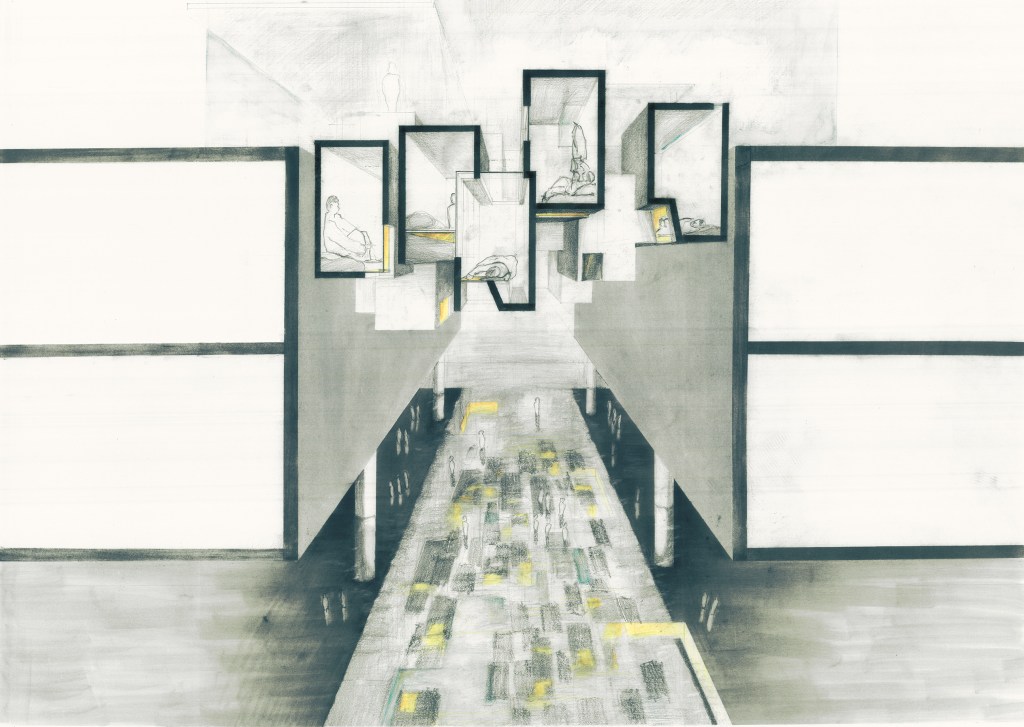
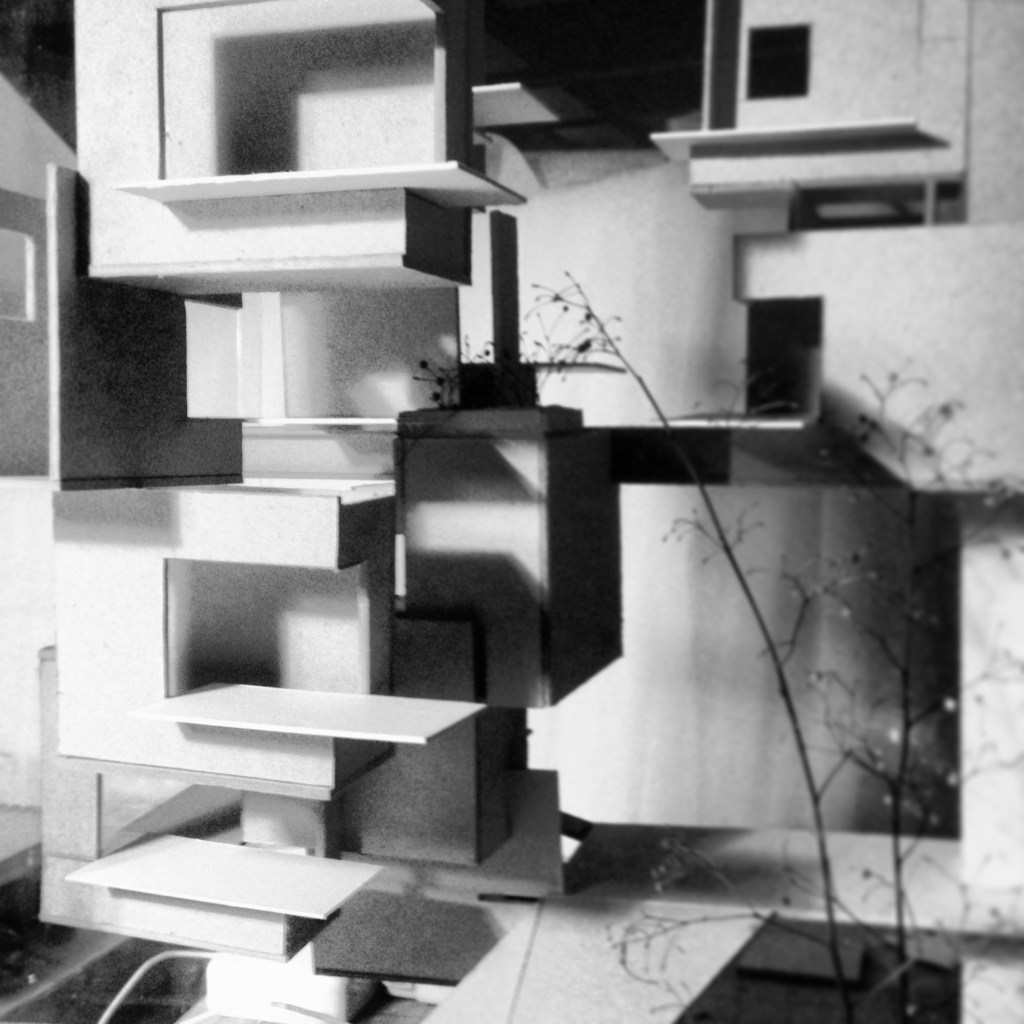
For the main part of design, project tries to apply previous research to building, building as a society of dreamers. Firstly, I isolate the design, ignore any exist context, and build a group of sleeping vessel with dynamic massing, and not located in anywhere, but float in the air. But from individual vessel in the group, people have some way to looking at the context in an indirectly way. A mirror surface underneath the group of sleeping vessel allows people could able to find the image of complex massing from individual vessel, such like looking at the city mass. And, individual vessel also included in the big image. The mass of building alters its scale from room, to building, and tries to evoke an awareness of connection between people and city; this awareness is possible to create a sense of dreamer’s society in the building.
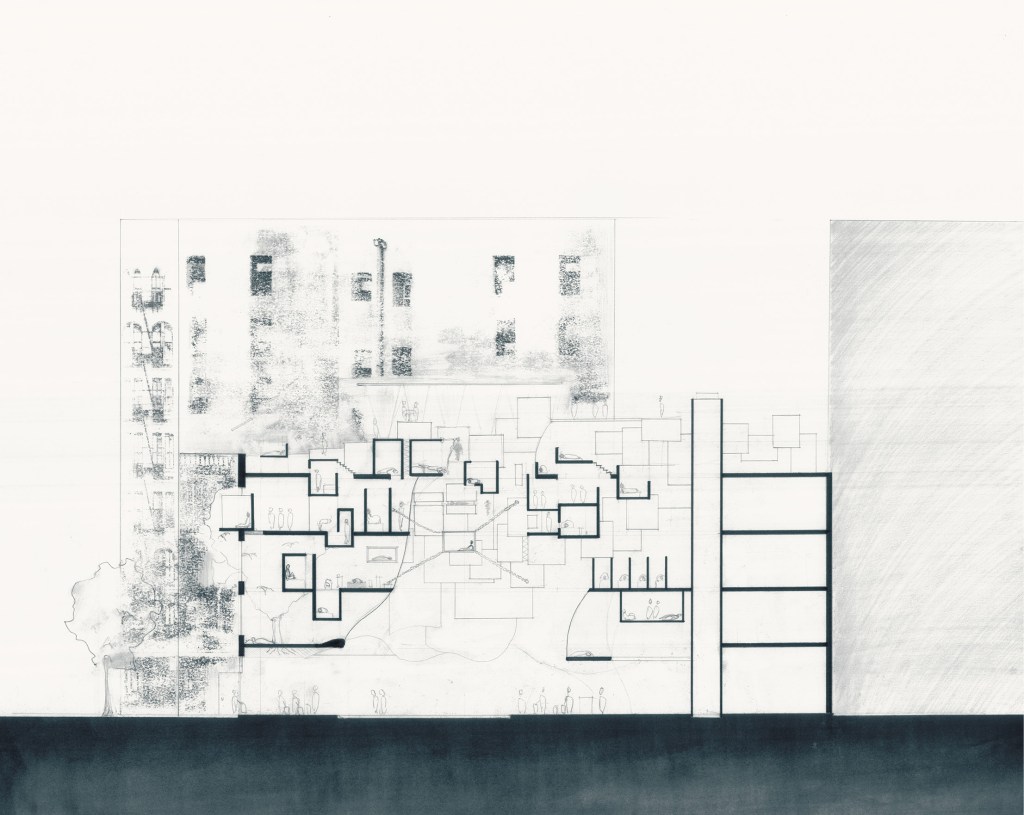
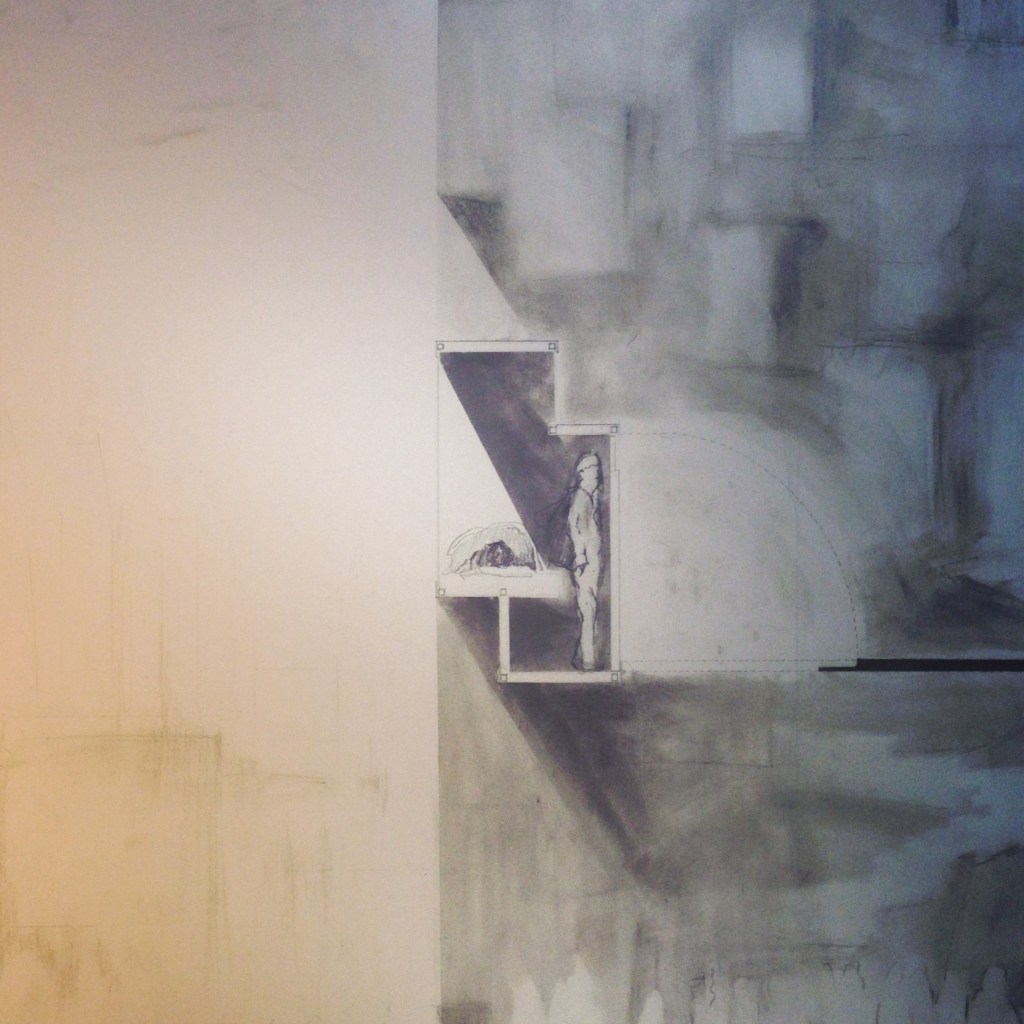
After non-context consideration design, I bring this image of awareness back to the exist building, conceptually build the transformation between exist room arrangement and the floating city. This part of work is working on a section view of model; the intention of this part is that extracting a soul of building as my strategy of design of building. A section drawing starts to explore the different possibility between multiple sleeping boxes in the entire space. But on the other hand, a conceptual strategy could help future development of building design. In the plan drawing, I assume building as a single room, and society as a single body; then I try to extract the strategy between body and room in entire building. And really individual rooms are grouped by the joint on “body” of dreamer society, become the extended feeler of these joints. Moreover, the indirectly connection may create by this strategy of floor plan. An experiment about abstraction of transformation between existed and floated boxes tries to extract the “soul” of this process. This “soul” will be the recombination from previous ideas in this thesis project – how this “soul” as a core strategy could formulate the building design, and manifest the relationship between people and tiny sleep space.
Context
There are different aspect of context formulated the process of research. Project started with my observation of city; then, I extracted some issues and fragment base on these observations. Readings and drawings are good supports when I was extracting issues and fragment. A little book on the human shadow by Bobert Bly let me not only think about physical world, but also consider the emotion diffusion around city.
The first observation was before the map drawing, I took long time driving around Portage Ave, and took video along my trip. In the same time, “The viewer’s mobility is inevitable, the viewer’s experience of a place is inarguable, but the site is not static either.”(Around the corner: A photo essay by Lucy R. Lippard). This notion led me that I start to change my view from human being to city itself. The dialogue between stone and life being was happened in my head. Then, I affected by Edward S. Casey that I started to observe city out of my perception. After these, made my map drawing, intersection drawing and three minutes movie with these ideas. (Looking around the Edge of the world: Contending with the continuist principle and the plenarist passion in Chora 5)
For the physical context of this part, map drawing is base on the area along Portage Ave in Winnipeg, and intersection drawing is my memory of a specific intersection at Graham Ave and Donald St in Winnipeg downtown. The movie base on the observation of Winnipeg and New York City. There also have a series of photograph done by the way. These photos show that people is the subject of city, but with dynamic conditions; and these condition cause different response of these individuals. Photos highlight the homeless people, which a ultra situation challenges people common sense, in order to describe another layer of scenarios in the city.
As mentioned before, the movie is part base on New York City; this was my first field trip. I lived in a hostel, which was becoming my site later. Site locates on the Bowery Street in New York City. It is the location of Bowery’s whitehouse hostel. The resent condition and situation in this 100 years building called Flophouse. It uses to an apartment with long-term occupancy, but operates as a hostel now. Moreover, site in the center of a dynamic area, like SOHO, Chinatown, Little Italy, St Mark… There have so many opportunities discover the critical engagement between people and artifacts.
And fortunately I met Allan Wexler in New York City; that conversation is the start point that I want to produce the drawing of 48 boxes of sleeping. The reading, The Box man by Kobo Abe provided me a good start of this drawing. “To construct your box there is no particular procedure to follow. First decide what is to be the bottom and the top of the box – decide according to whatever design there may be or make the top the side with the least wear or just decide arbitrarily…..” ; this let me created many interesting variation of boxes in the drawing.
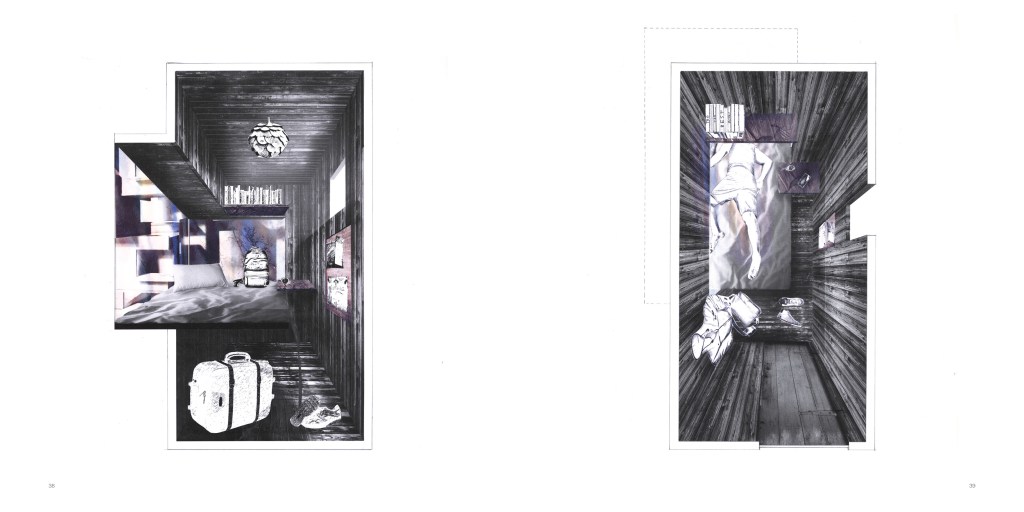
When I was drawing boxes, I read some other readings: Making space by Antony Gormley, Microscopic Designing Methodology by Hiroshi Nakamura, The man who mistook his wife for a hat by Oliver Sacks. And they let me formulated the idea of extended feeler of body. A study about the different position of myself in the hostel room tries to manifest the relationship between the body and physical wall of room. My body changed the posture within a limited space, and adjusts into the physical space, but conceptually warps the emotional wall between different rooms. This study also a test of how brings an indirect connection between in and out of physical boundaries into not only individual but also collective minds.
During the field trip in the ShenZhen, China, which is a city with rapidly development, this city manifests a strong image of juxtaposition between city and urban village. This juxtaposition refer from the jumping of the building scale, life style, political issue and so many society problem; then, relay to my thesis, these maybe become other case study of flophouse from another culture background.
Bibliography
Antony Gormley, Making space, (BALTIC, 2004)
Bobert Bly, A little book on the human shadow, (Library of Congress Cataloging-in-Publication Data, 1988)
Edward S. Casey, “Looking around the Edge of the world: Contending with the continuist principle and the plenarist passion” in Chora 5, McGill University. History and Theory of Architecture Graduate Program, (McGill-Queen’s University Press, Montreal, 2007) 151-175
Hiroshi Nakamura, Microscopic Designing Methodology, (INAX, 2010)
Joseph Rykwert, “The sitting position – A question of method” in The Necessity of Artifice, Joseph Rykwert, (Rizzoli, New York, 1982)
Kobo Abe, The Box man, (Knopf, 1974)
Lucy R. Lippard, “Around the corner: A photo essay”, In Site Matters: Design Concepts, Histories and Strategies, ed. Andrea Kahn and Carol Burns (Routledge, New York, 2004)
Oliver Sacks, The man who mistook his wife for a hat, (Simon & Schuster, 1998)
Simon Unwin, “Constructing place… on the beach”, in Constructing Place, Mind and Matter, Ed. Sarah Menin, (Routledge, London and New York, 2003) 77-87
Simon Unwin, “The wisdom of the sands”, in Primitive: Original matters in architecture, Ed. Jo Odgers, Flora Samuel and Adam Sharr, (Routledge, New York, 2006) 221-226
 MYRIADS Studio 大千设计