
Kaizhou New City Young Designer Competition Entry 2020, Deyang, Sichuan
Park City + Postdigital Lifestyle



设计概念 Concept and Background
Nearly forty years of urbanization process promotes the economy to increase rapidly in China; simultaneously, it also resolves the absence of the ecological system in the built environment. As part of the Chengdu East development movement, KaiZhou City claimed to become a city building with the ecosystem, as the urban environment within the park. Inevitably, KaiZhou City will become a crucial ecological resource in the suburban area near the Chengdu Metropolitan Circle. However, in the history of the built environment, nature and artifacts always try to take over the place one to another, always trying to invade the realm of others. In the 1950s, Landscape Architects started to investigate the innovative way to reconstitute the ecosystem of the urban infrastructure, seal the gap on the co-existing of nature and artifacts, and eventually become the Landscape Urbanism as we know currently. They declaim that the buildings and structures will be the extensions or the rises from the landscape in their methodology, support with infrastructure as the performative medium, without against the ecological demand.
中国近40年来的高速城镇化进程极大的推进了中国的经济发展,但是同时使得城市生活中的生态绿洲也变得难能可贵。作为成都东进计划之一的凯州新城,以公园城市为价值标准进行开发必然会成为成都的近城市圈内稀有的城市生态资源。然而,在我们人类的城市发展历史中,生态环境与人造环境之间的总是存在着此消彼长的关系,总是互相在对方存在的边缘试探。上世纪五十年代开始,景观建筑师开始发掘重组城市生态系统的方式,从而拉近人造环境与自然环境共存距离。建筑物与基础设施在景观都市主义中被看作的是景观的延续与地表的隆起,并建立可以被用作不违背生态需求并可行使功能的载体。
Meanwhile, our society already stepped into the post-digital era. Computational and informational environments no longer need highlighting to show the present and highly integrated with the mediocre life of human beings. The term post-digital originally comes from the art filed, Mel Alexenberg uses it to describe the interplay between the cyber world and reality. As the Chinese government recently advocate the “New Infrastructure(新基建)” development strategy, digital fabrication, IoT, AI technologies will enter a new era of development. As Nicholas Negroponte addressed, “Like air and drinking water, being digital will be noticed only in its absence, not by its presence.” Those technologies will bring the co-existing condition of nature and the built environment to a new dimension. With the innovative material, low pollution energy, and virtual reality assistant, the future model of the service industry base on the post-digital era will occurring in a short period of the future.
同时, 我们的社会生活模式也早已进入了后数字化时代。计算机化与信息化已经不再是一个需要被特地强调的存在条件,而已经以极大比率的融入了我们的日常生活。后数字化一词最早来自于艺术领域,Mel Alexenberg将其用于描述网络世界与现实世界的互相作用的关联性。伴随着中国提出新基建战略,数字建造与应用,物联网,人工智能技术都将进入及其迅速的发展阶段。引用Nicholas Negroponte的描述, 数字化在我们的未来生存环境中将会如同空气和水源一样,只有在短缺与消失的时候才会被察觉。伴随这些科技的发展,在物理层面人类已经几乎迈进了营造自然环境与人居环境共存的新维度。新型的制造材料的研发,能源污染的降低,以及线上虚拟科技引擎的支撑,后数字时代的服务产业运作模式已经未来可期。
We take Chengdu as the one of the capital city of the food, and the “New Infrastructure” strategy as the background starts the conversation to unfold a sample media for opening up an opportunity between the digital and ecological lifestyles. We claim that, as the park city in the new era, it will be capable of providing rational evidence of how to achieve the fusion between the post-digital built environment and the ecological environment.
借用成都作为中国西南地区的美食之都,我们在这个项目中将选择外卖快递服务为讨论的基础,结合国家新基建发展的的趋势,展开这个令民用快递服务成为开拓数字化生活与生态生活之间新型结合方法的案例媒介。我们在此提出一个愿景,一个新时代的生态公园城市,是有能力提供多样的可能性去解决后数字时代人居环境如何合理地融入生态环境的问题。
设计策略 Design Strategy
Because of the challenge of the site’s scale, we decided to operate the design strategy in a condition-specific method, rather than location-based. On top of this, we generate two main principles of the strategy – the Node space design principle and the Space distribution principle.
由于凯州新城中央公园的场地巨大,在设计策略上,与其取特定地形进行设计,我们着重于提取出场地中的重点要素,并提出节点空间设计与空间选址设计两个设计原则。
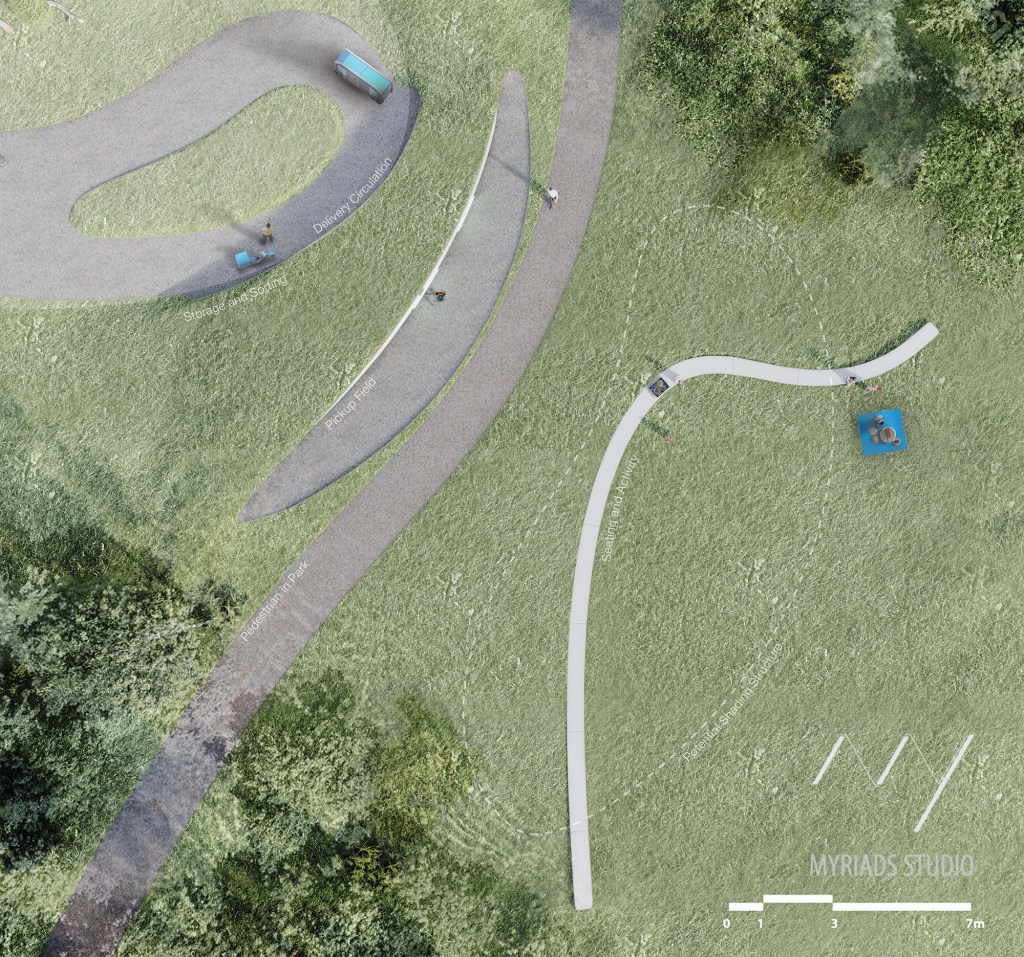
空间序列上按照,物流流线,自动储存,取物场地,人行流线,座椅及活动场地,自然以及渡槽景观的线性顺序为基础原则,同时切合场地中大量存在的缓坡地形,作为空间节点设计的形成逻辑。在平面图中展示的是其中某一种自拟缓坡地形中基础线性原则在空间上的体现方式。并可根据后期需求增加灵活的额外家具。由于整个结构对场地影响相对很小,留下了大量的空间给未来可能性的遮阳遮雨类构筑物。
The Node space Design:
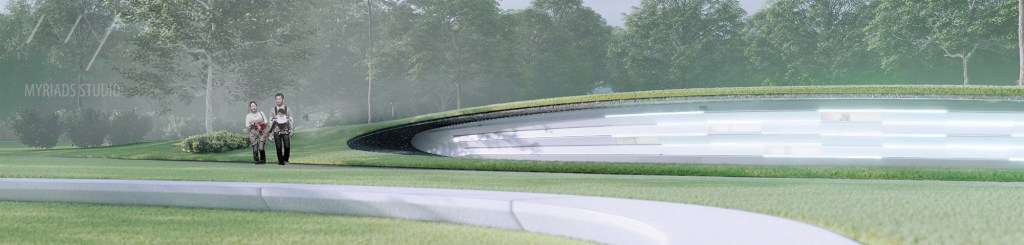
This project established a linear spatial relationship, a sequence with the delivery circulation, the autonomous storage and sorting system, the pick-up field, pedestrian circulation in the park, the seating and activity area, and the landscape’s views aqueduct. This linear relationship integrates with the typical shallow slopes on the site as the device to drive the formation of node spaces; the plan above is showing one possibility of how this relationship allocates on the ground. Additionally, it could also take advantage of the low impact structure to add flexible furniture and the opportunity to build a shading structure.
空间序列上按照,物流流线,自动储存,取物场地,人行流线,座椅及活动场地,自然以及渡槽景观的线性顺序为基础原则,同时切合场地中大量存在的缓坡地形,作为空间节点设计的形成逻辑。在平面图中展示的是其中某一种自拟缓坡地形中基础线性原则在空间上的体现方式。并可根据后期需求增加灵活的额外家具。由于整个结构对场地影响相对很小,留下了大量的空间给未来可能性的遮阳遮雨类构筑物。
The Space Distribution:
本设计在场地中的地点选择原则是,以渡槽为景观视觉中心,结合与渡槽有稳定相对关系的缓坡地带为选址范围,在其中寻找与城市交通体系之间的距离关系后,形成优化的公园内配送距离。这个原则延续了空间节点设计的线性逻辑,并放大体现在城市尺度中。
This project aims to use the existing aqueduct as the focal point of the landscape, accompanying the shallow slopes around as the base realm to develop an optimized distancing strategy of food delivery in the central park. This strategy is using the same principle as the node space design but applies on the urban scale.
 MYRIADS Studio 大千设计